Safety
Health and safety are a critical part of operations at the Amrize Cement Plant.
We have a stringent safety policy for our employees and subcontractors, and participate in public health programs that benefit both our workforce and local communities. Amrize Canada aims to be among the safest companies in the world, promoting safe behaviour not only at the workplace, but also at home.
In 2016, the Amrize Exshaw Cement Plant team reached a remarkable milestone of one million hours worked without a Lost Time Injury (LTI). During our three-year modernization and expansion project, we maintained an impressive safety record of 2.5 million worker-hours without an LTI.
Since 2002, we have reduced the frequency and severity of work-related accidents within the Amrize Group. This progress is thanks to our robust Health and Safety management system, which sets minimum safety standards across all our sites.
There is always more to be done.
To achieve our goal of zero fatal accidents and keep lost time injuries to a minimum, we:
Inform and train employees and subcontractors on activity-related risks.
Ensure strict adherence to safety standards.
Establish incident reporting procedures and conduct regular audits for safety improvement.
Identify and promote best practices across all worksites.
Vibrations Monitoring at the Exshaw Plant.
The Amrize Exshaw Cement Plant monitors ground vibrations 24 hours a day, 7 days a week using two vibration monitoring stations.
One monitor is located at the Exshaw Water Treatment Facility, and the second is located in Lac des Arcs at a location selected in collaboration with the local community. These monitors continuously measure vibration levels to ensure plant activities remain within established industry guidelines.
To promote transparency and open communication, the vibration data is available for the public to view using the link below:
Website: www.blastvibrations.com
User Name: amrizeexshawguest
Password: Exshaw1!
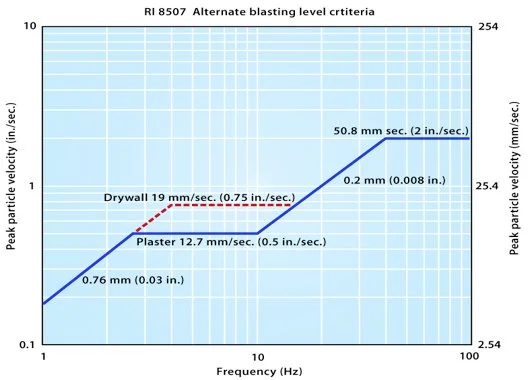
Vibrations are measured in millimeters per second (mm/s) and evaluated using the USBM Z-Curve, the industry standard used to assess vibration impacts. The curve, shown below, relates vibration frequency to peak particle velocity and provides thresholds designed to protect the most sensitive components of typical residential structures, such as drywall and plaster. These structural thresholds generally range from 20–50 mm/s, depending on frequency. For reference, people can begin to perceive vibrations at approximately 0.5 mm/s, although perception can vary depending on location, ground conditions, and individual sensitivity.